Showing posts with label GMT. Show all posts

Sunday, 7 January 2024

The Last Hundred Yards Reviewed: The Ultimate WWII Tactical Game

The Last Hundred Yards (LHY) is a series of tactical board wargames in a Second World War environment designed by Mike Denson and published by GMT Games. The LHY system has recently  become my number #1 tactical game of choice in detriment of Advanced Squad Leader (ASL). The LHY cover small mostly infantry-based skirmish actions at company/platoon level, with an innovative sequence of play resulting in fun, fast paced and furious engagements.

The terrain scale is 1 hex = 50 yards and the time-scale is variable, each "turn" or combat cycle representing between  2 and 5 minutes. Counters represents squads and sections (half squads), platoon leaders, support weapons (HMG/MMG, flamethrowers or light antitank weapons squads) and individual vehicles. 

Additionally there's a myriad of auxiliary counters to keep a record of activated units, fire effects (more on this later), heroic units, etc  as well as other counters representing minefields, foxholes, smoke of fortified positions among others.

The quality of production is high as usual in GMT: units counters are large  9/16 of an inch squares (3/4 of an inch for auxiliary counters) and maps are very nicely printed giving a sense of "3d" depth; the maps are generic geomorphic, double sided printed and can be arranged in almost infinite combinations. 

When compared to ASL, there are a few aspects that are worth taking into consideration:

The first is the length and complexity of rules: you got everything you need to play in a 34-pages long publication (the current rules book version 3.1). There's also a complementary "playbook" with extended illustrated examples of play of the different rules sections. And the scenarios (or "Missions" in LHY parlance) can include some (very few) special rules applicable to that particular situation. 

Second, the game is played using the historical orders of battle. The forces are organised in companies of three platoons, each led by a platoon commander and depicting three squads and potentially some support weapons. You can argue that these were "paper-strength" orbats; but missions (based on historical real engagements) take into consideration the real manpower of the units involved, adjusting the forces accordingly.

Third you play against the clock and the casualties. Missions may set some objectives, but you must accomplish the mission in a fixed timeframe (and time passed is variable in each turn) and not incurring excessive casualties. Unlike ASL for example, where you can win a scenario even with only one suqad left on the table, in LHY the depletion of your manpower counts against you. 

Finally, the very innovative game system based on an action/reaction chain of the players' units, reflecting the combat friction typically found in the battlefield.


Overview of the Playing System

How the system works? The sequence of play is structured in 7 phases or steps. 

Phase 1 (initiative) is to determine initiative rolling a dice and winning the side with the higher outcome. Note however that there is no full randomness. Usually the attacking side owns the initiative at the start and will have a positive DRM to the die roll in subsequent turns. 

Once initiative is resolved we entre into Phase 2 (activation), the nitty-gritty  of the system, based on an action-reaction chain. Activation is made by company and then by platoon within a company. Two platoons of the same active company  may coordinate actions with a die roll, but usually you go platoon by platoon  (To clarify: as the attacker, I declare that Able will be my active company; from there I activate platoon by platoon).

The selected platoon may undertake different possible actions: move, fire, withdraw, assault, call for mortars, recover from disruption or just stay put. Once the player declares the end of its platoon activations, the opposing player can react with the units that saw an action (i.e.: in LOS of an activated enemy undertaking an action). When the opposing player declares the end of the reaction, the player with the initiative may react to the enemy reactions or else conclude that platoon activation and activate a second platoon. Reactions do not need to be just shooting someone getting into LOS, but players can move units to get a position of advantage or to avoid being assaulted.

As you see the system creates a cascade of action/reaction moves. Interesting, shooting is not resolved automatically in this phase; therefore you decide your actions/reaction without any knowledge of what effect shooting had on the enemy unit. This adds another layer of friction to the game.

Introducing shooting, the system rewards proximity to the target which basically implies that little harm is made when shooting at three hexes or more. Fire effect is calculated as a "dice roll modifier" ranging from -4 to +3. The base number is the firepower of the unit shooting and the distance to the target, then adjusted by a list of modifiers (cover, hindrances, concealment, density of manpower in the target hex...) to get the final fire modifier.  

One example to illustrate the mechanics. 

  • A German rifle squad with a firepower of 1 and fire range of 10 hexes, shots at a US squad in a forest at 4 hexes distance. 
  • Crossing range (10) with the distance (4) in the Small Arms Fire Table, the German squad will have a base number of 0 (+1 for firepower less -1 modifier for distance).
  •  As the target unit is under cover of some woods, there's an additional -1 penalty to the shot, resulting a total fire modifier on -1 

 Note: should the Germans have fired at 3 hexes or closer, the modifier for distance for a 10 fire range squad would have been 0 and therefore the final fire modifier  would have been 0: +1 fire power + 0 distance modifier -1 for woods).

At this stage of phase 2, the target unit under fire will be marked with a "-1" Small Arms Fire Die Roll Modifier (SADRM) counter, but the actual effect of the fire will not be resolved yet. 

Once the active player concluded activating all the platoons and both players finished their respective reactions,  the play sequence moves to Phase 3 of Fire Resolution. As explained, the units under fire are marked in Phase 2 with the SADRM modifier. Firer rolls a 10-sided die, adds the modifier and compares the final result to the unit cohesion level: if lower, no effect; greater, the unit disrupts; if 10 or higher, the units suffers a casualty.

Assaults resolution is done in Phase 4 (after firing). Like shooting, assaults take place in Phase 2 as part of the units activations, but the effect of the melee is unknown until later in the sequence of play.

Phase 5 relates to mortars: now it's the time to extend fire missions called in the current turn; or to attempt  contacting the battery for the following turn. 

In Phase 6 (Time Lapse)  the active player rolls for time spent in the turn, which is variable between 2 and 5 minutes

And the final Phase 7 is a clean up phase in which players remove different game markers, the smoke counters placed in Phase 2, or place conceal markers on units out of LOS, etc

This is a nutshell how the system works, being very unique and distinctive compared to other tactical systems in the market. The rules book of course have many other chapters dealing with vehicles, anti-tank fire, airborne troops, special national characteristics (applicable to Russian and Japanese units), night fights, etc. 

If I have to summarise the game, the system rewards the player gaining and keeping the initiative. Having the initiative is in fact a key driver to win a game: as an attacker, getting the initiative allows great flexibility of action, with the defender only able react to your moves. If on the contrary, the defender gets the initiative, he'd be able to slow down the attacker, only having to decide how much time for space he's willing to trade.

Current product line and future releases

The LHY series currently has four game boxes (or "volumes") and one "mission pack" (set of scenarios)

Volume 1 ("The Last Hundred Yards") covered the US and the German army in the European Western Front during 1944 and 1945

Volume 2 ("Airborne Over Europe") introduced US and German paratroop units as well as British armour units (representing the XXX Corps assets for the US side Market Garden) 

Volume 3 ("The Solomon Islands") introduced the Japanese Imperial Army and the US Marines in Guadalcanal.

Volume 4 ("The Russian Front") very recently released (December 2023) covers the Eastern Front battles confronting the Red Army and the Germans between 1943 and 1945.

Mission Pack 1 provides some new maps and mission cards to play in the European Western Front.

In relation to future releases, the only confirmed addition to the series will be Volume 5 ("For King & Country"), introducing the British Forces in Western Europe during 1944 (Normandy and Market Garden). Vol 5 is currently in GMT's P500 page and likely to be released in late 2024

In a recent thread in BGG, Mike Denson announced he's taking a step back after the release of Volume 5  but will leave a committed and experienced team in place to ensure continuity of the system. After Vol 5 the team seems inclined to return to the Eastern Front battles but focused on the earlier war period (1941-43); no official release date yet, but sometime in 2025 likely.    

Convinced to jump-in? Some important considerations

So you have been convinced and want to play LHY? You must then consider the following:

Vol 1 and Vol 2 are core acquisitions that you need to have. These are needed to play the Russian Front volume, the Mission pack and the future British volume. 

Volume 3 (The Solomons) on the other hand, is a self-contained game; if your focus in the Pacific, don't need to buy the rest of the boxes. 

The designer is continuously updating the rules and support materials (playbook, tables)  with the the introduction of new armies and suggestions from players across the world. For that reason,  all the booklets and support tables coming in the different game boxes are outdated.

The GMT website posts the most recent versions of the rules, tables, etc. Check regularly for new version, to uploading and eventually printing. The latest version of the rules (as I'm writing this) is 3.1 The changes versus version 3.0 (included in the latest Russian Front game) are minimal but I suggest checking v 3.1and marking the amended paragraphs in the 3.0 printed booklet.

This also applies to the missions or scenarios: GMT has released last December the amended missions in downloadable pdf format for all the different volumes (including Russian Front!.. I wonder who is in charge of quality control at the firm). There's lots of small but nonetheless significant, changes that you should be aware of before playing any mission. 

Finally, if you haven't done it yet I strongly advise to sign in to the LHY's BGG website page. There you'll find a very active and supportive community of players, with tons of reviews, videos and other downloadable materials. My experience requesting clarifications and questions couldn't have been better indeed. Designer Mike Denson is also quite active in the forums.  


GBoH and LHY - Two of my favourite rules systems


Monday, 3 April 2023

What Makes Operation Market Garden so Appealing?

Territorio Grognard is arguably one of the best hobby podcasts in Spanish dedicated to board wargaming. In late February, they recorded an episode on Operation Market Garden (Sept 17th-27th, 1944), coinciding with the release of a Spanish edition of GMT's Mark Simonitch Holland '44 game by NAC Wargames.

Source: Imperial War Museum
 

I know Franjo one of the podcast producers and, as I am a fan of all things Market Garden, he contacted me to make a short intervention in this episode explaining what makes this operation so appealing to me. 

A simple question doesn't mean a simple answer. True,  Maket Garden is one of my favourite Second World War operations; but I never structured my thoughts on why. It may be related to the fact that in the summer of 1977, I was studying English in London and had the opportunity to watch A Bridge Too Far in the theaters there. But I got really hooked on the topic more recently, after listening to Nick Skinner (founder partner of Too Fat Lardies with Richard Clarke) disucssing the operation in one of the Oddcasts

But returning to the original question, I think we should put it in a different way: what doesn't have Market Garden to be one of the most appealing moments in the 2WW?

Firstly, it is a daring and very bold plan, aiming to cut the war short. Intriguingly, the operation was proposed by Field Marshal Montgomery himself, usually considered (wrongly!?) one the most cautious Allied commanders.

Second, it is one if not the most, epic operation of the whole war. A thrust into Germany to build a bridgehead over the Rhine, outflanking the main defence lines at the Ruhr area ... and to Berlin and beyond.  

Source: Wikipedia

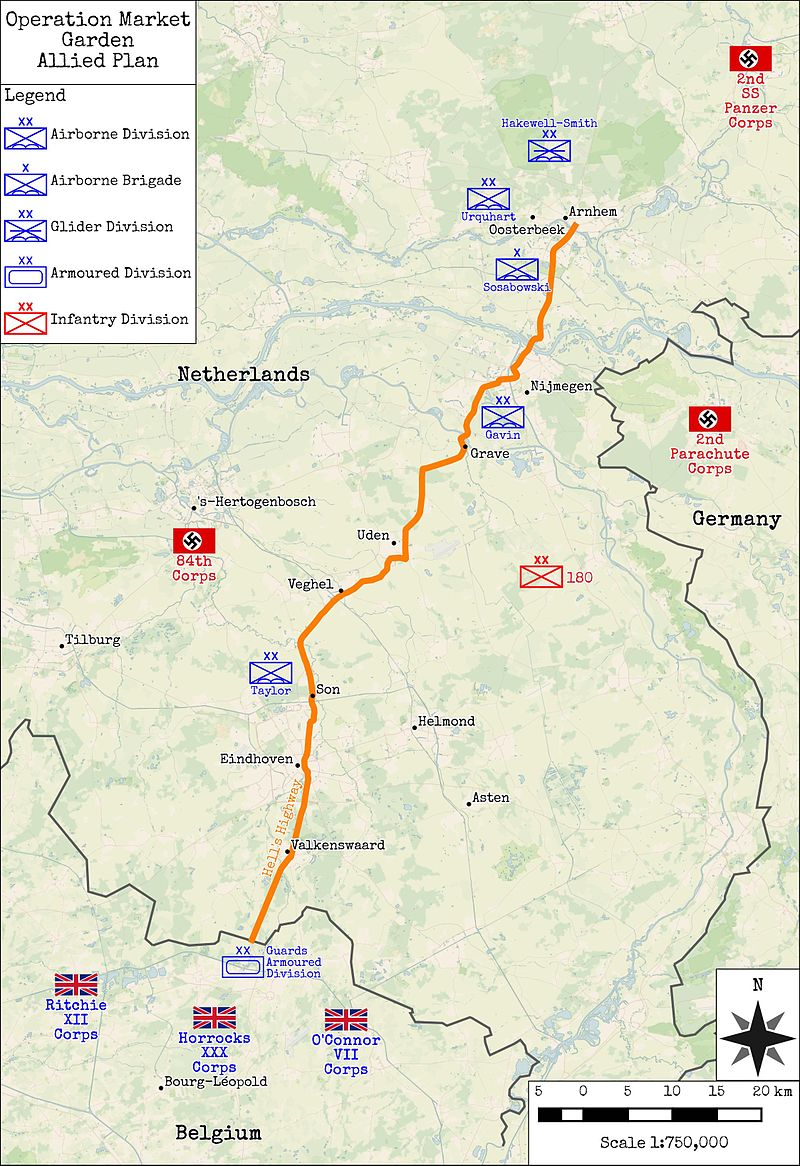
For this purpose, three airborne divisions (US 101st and 82nd, and British 1st) would jump in a corridor over 100km long behind the enemy lines, while a powerful armoured force (The British XXX Corps of the 21st Army Group) would advance and connect the three landing zones. 

The task of the three airborne divisions was to capture and defend nine critical bridges, spanning over six major riveras and canals in The Netherlands, until being relieved by the land forces.

For a wargamer, Operation Market Garden opens a wide array of gaming opportunities at different levels, from high strategic-operational levels to very low tactical encounters. 

Boardgames are probably best suited for the former. Historically, the airborne landings caught the Germans by surprise and were a total success. 

However, these prompted a fast and violent reaction, completely unexpected by the Allied planners, who thought the Germans on the ground were just second rate units and demoralised beyond recovery.

The Germans counterattacks threatening the XXX Corps line of supply along route 69 (the famous "Hell's Highway"), and the fighting to control some of the key bridges along the route are a fantastic context for operational-level games (more on this later). In parallel to the XXX Corps thrust, the US airborne units must simultaneously take and control bridges, defend the landing zones (needed to bring supplies and reinforcements) and retain control of route 69.

British landing and Attacking Routes
The 1st British Airborne Division  jumped at the tipping point of the Market Garden plan. It went almost immediately on the defensive after landing due to the quick reaction of the local scattered German forces, initially forming around the so-called Kampfgruppe Krafft; but later in a more organised way around the assets of two SS divisions (9th and 10th) refitting in the area .  

Therefore, a high level game would see lots of action around the supply routes as the German pressure increases in the post-landing reaction, attacking even at very unfavourable odds. Allied players will have to assume two opposite roles: on the offensive in the south with the armoured corps to link with the different airborne divisions; and defensive in the north to defend any initial gains made in the Arnhem/Oosterbeek area. And players (or group of players) on both sides would have to run against the clock!

The possibilities for low level games using miniatures are also endless. Most wargamers have focused mainly in the desperate battles of the British Airborne Division in Arnhem and surroundings (see for example the event last October at the Oosterbeek Museum organized by TooFatLardies). 

While epic and heroic, there are many other alternative scenarios to be played at the scale of battalion or platoon with US Airborne division or with detachments of the XXX Corps: attacks and counterattacks around key bridges; contested epic river crossings; urban fighting (Nijmegen for example); ambush actions on British armoured vanguards... Also noteworthy the variety of army units and motorised hardware used by the Germans to create very attractive visual displays on the gaming tables.

Wargaming Market Garden

In the podcast commented above, I was also put a couple of follow up questions: my favourite wargames to play the operation and reading recommendations.

As for wargaming, my first time recreating market garden was with Storm over Arnhem (SOA), a venerable and iconic game released by the defunct Avalon Hill in the 1980s. This was one (if not the first) to use the area-impulse mechanism instead of the traditional hex-grid map, a revolutionary change at the time. As the title suggests, the game is focused on the British Airborne Division's desperate fight for the bridge at the Arnhem-Oosterbeek area. 

The two more recent games I have been playing cover Market Garden fully at operational level: Monty's Gamble and Holland '44

Monty's Gamble fom Multi Man Publishing is another area impulse based game but with a more sophisticated level of development than SOA.  I own the second edition released in 2019 and still widely available in hobby shops. The rules are reasonably simple to learn and the game is highly replayable. 


Monty's Gamble Board

 
SOA Board

Holland '44 form the GMT stable and designed by Mark Simonitch, is my number #1 game for Market Garden. Although more complex than Monty's Gamble, it is fairly accesible for anyone with some track record in playing wargames (but I wouldn't recommend to get anyone introduced to the hobby).

 The game is a very realistic portray of the operation, offering both Allied and Germans opportunities to win based on the different victory conditions. I have played it several times; the game helps to understand the tough choices of the Allied forces (racing to the north but forced to keep the lines of supply open at the same time), and the problems faced to the Germans receiving piecemeal but increasingly larger reinforcements to defeat the Allies.

The recently released Spanish version of the game by NAC Wargames is a work of love: incredible high-quality components (pre-cut counters,  mounted and paper maps, support tables...), a new scenario published in C3i and a new revised and upgraded edited version of the rules. In fact (confession time) I sold my original GMT English copy to acquire the new NAC edition after watching an unboxing video...and  no regrets so far.

On the miniature gaming side (see my previous post discussing board vs miniature gaming), Chain of Command is my best option to play skirmish level actions, as explained before. Too Fat Lardies co-founder Nick Skinner has been working and testing extensively a supplement or handbook focused on Market Garden, that we expect to see released sometime in 2023. 


Notably, TFL organised a game day at the Airborne Museum in Oosterbeek in October 2022 and I have just heard the news in a recent Oddcast that a new event is scheduled at the museum premises by the end of October 2023.

Operation Market Garden: What to read?


Cornelius Ryan "A Bridge Too Far" is the early, and now classical work on Operation market garden, that supported the script of the epic film with the same title.

Unfortunately, the book (unlike the film) has not aged well, and some key wrong ideas and facts about the operation have become undisputed myths over time.

More modern works and research are removing some of these myths or questioning decisions taken by some Allied leaders on the ground, like Gavin of the US 82nd Airborne.

For an overview of the whole operation, I recommend  "The Battle for the Bridges" by Anthony Beevor, released in 2018. Note: I'm not a devoted fan of this military historian and has found his books to be quite irregular. 

But this is a good book to start, despite that some of the myths commented above still survive in his work (for example, the famous "stop to brew tea" of the Guards tanks in Nijmegen after taking the bridge over the Waal).

Robin Neilland's "The Battle for the Rhine 1944" covers the battles from the Normandy breakouts to the Ardennes, and helps put in context the two landmark operations of this period (Market Garden and Watch Am Rhine). This late British historian reviews in depth and makes a strong case in favour of the odds of success of Market Garden.

I have two favourite books that usually I read every year. The first is Martin Middlebrook's "Arnhem the Airborne Battle"  dealing with the fight of the British Airborne Division. It is a book rich in details, using first hand views based on veterans' personal letters, diaries and interviews,  and extremely well written and documented.

The second is focused on the other side of the hill: Robert Kershaw's "It Never Snows in September". This book tells the story from the German point of view and it is the perfect complement when you read Middlebrook's for example. Also extremely well written and documented, provides a detail review on how and why the German reacted so fast to the landings, as well as a critical view of some of the Allied actions and decisions. A must-have.   

Finally, I'd like to bring your attention to a short, widely unknown but intriguing and interesting research study written by Dutch military historian R.G. Poulussen and titled "Lost at Nijmegen: A Rethink on Operation Market Garden".

As the title suggest, the author's argue that Market Garden's main fault was Gavin's procrastinating to take and secure the bridges over the Waal river. The XXX Corps' armoured spear points actually arrived to Nijmegen within schedule despite the problems faced earlier in the operation, only to find the bridges still under German control. 

This had a twofold impact: it forced the British units allocated to reach Arnhem to fight a battle to control the bridges; and for the Germans, once Frost's resistance crumbled at the Arnhem bridge, the delay allowed them to fortify and reinforce the section between Nijmegen and Arnhem (The "Island") forfeiting any possibility of the Allies to reach and capture the bridge over the Rhine.


Thank you for reading this. Do you have any special operation or battle close to your heart? Feel free to leave your comments