Showing posts with label IIWW. Show all posts

Monday, 15 December 2025

Thunder at Cassino: Revisiting an Old Friend


On December 13th, five veteran members of Madrid's Dragón Club decided to dust off and display on on a table one of the most venerable games : the legendary Thunder at Cassino by Avalon Hill, published back in 1987.

The move was challenging: how well stood the test of time? Would the happy memories of games played in our youth forty years ago turn into disappointment with this revival?


 As it turned out, nothing could have been more satisfying. All five  agreed that the game could be reprinted exactly as it was then, perhaps with updating the arts, although those ASL-looking unit counters certainly have their own charm.


The session began at 10:00 a.m. and ended close to 9:00 p.m. (stopping as usual for lunch). Three Allied players faced off against two Germans in hard-fought battles, especially around the town of Cassino. There, the Green Devils mounted a stubborn defence
, clawing their teeth and hands to the rubble, ambushing men and tanks, and exacting a heavy toll in casualties (both their own and those of the Commonwealth troops) for every inch of ground gained by the attackers.

On the slopes of the hill crowned by the Abbey fighting was less intense due to the Allies’ timid advance. The Germans took advantage of this to thin their lines and send reinforcements to the real hotspot: the town and its surroundings.

With only two turns remaining, the swords are still drawn. The Allies do not have yet enough victory points; but the stretching German “thin field grey line” is tenuously holding a big bag of critical victory locations… and any breach in the line could allow the Allies to turn tide in a very short time span.

End of Turn 7 - Red line marks the Commonwealth troops advance

 We hope to return to the battlefield during the Christmas holidays… so stay tuned for future newss.


Wednesday, 10 April 2024

The Savage Storm: The Battle for Italy 1943 by James Holland


James Holland, along with Peter Caddick-Adams and Alex Kershaw, forms my favorite trio of World War II military historians. For me, Holland, in particular, has become a niche writer, covering topics not frequently addressed by other writers (such as the Malta book) and adopting distinctive new angles when interpreting extensively researched battles or campaigns (as seen in the Normandy '44 book or the two tomes on the War in the West, 1940-43). For this reason, I tend to buy and read any new publication by him.

The Savage Storm: The Battle for Italy 1943 is Holland's latest book published in September 2023. As usual by the author, this is a thick tome of circa 600 pages, including a useful map section and lavishly illustrated with both contemporary photos and others taken by the author while walking the main battlefields 

The book epitomizes Holland’s approach. As the author rightly points out in the book's final pages, "the war in Italy is largely forgotten today, except for Cassino and Anzio…" Additionally, he covers in detail the poor design and execution of the campaign by both the Allies and the Germans. The result is a harrowing, brutal, and ultimately futile campaign, with casualty rates in the contending armies surpassing those of the Great War and inflicting a level of suffering on the Italian people hardly seen in other war theaters in the West.

"The Savage Storm" picks up where Holland's previous book, "Sicily '43," left off, with the retreat of Axis forces through the Messina Strait into Calabria, and concludes in December 1943 with the Allies halted at the Gustav Line in west-central Italy and at Ortona on the Adriatic coast. During this period between September and December 1943, the Allied Fifth and Eighth Armies suffered close to 35,000 losses, while the German Tenth Army endured 13,400.

The campaign faced numerous problems from the outset on the Allies’ side. The decision-making process was muddled by strategic political considerations and a significant disagreement between Britain and the US regarding where to concentrate the center of gravity in the West.

Political considerations included the fear of losing the initiative after Sicily if Italy was not assaulted, the presence of a powerful but inactive army in the Mediterranean, pressure from the Soviets on the Western Allies to open a second front in Europe, Prime Minister Churchill's ambition to extend British influence in the Mediterranean, British concerns that the US might prioritize the Pacific if no progress was made in Europe, and the opportunity to use Italy as a launching point for Allied air attacks on German and Austrian manufacturing centers.

The disagreement between US and British political and military commanders revolved around the center of gravity of Allied strategy in Europe. The US favored focusing efforts on assaulting France in May 1944, considering Italy as an undesirable distraction that could divert significant military assets from the main campaign. Conversely, for the British, Italy presented an opportunity to attack the Reich from its perceived "soft belly," remove Italy from the war, and force the Germans to divert resources from France.

Ultimately, the Allies greenlit the invasion of Italy but committed half-heartedly to the operation. There were no clear medium-term objectives set at its inception, aside from establishing advanced bases for the Air Force bombing campaign on the Reich or capturing Rome (more a political than a military objective). Many planning assumptions proved unfounded, lacking supporting intelligence evidence, such as the belief that the Germans would retreat to northern defensive lines without contesting Allied landings in the South. Moreover, the allocated resources were insufficient for the task, exemplified by the near disaster of the Salerno landings, and were further constrained by preparations for Operation Overlord.

Allied challenges multiplied as the mountainous terrain, numerous east-west flowing rivers, lack of modern road networks, and deteriorating weather hindered their ability to leverage mechanized mobility and air supremacy.

On the German side, the popular perception of a masterful army conducting strategic retreats and fighting to the last man hardly withstands scrutiny. The reality was an army poorly led by "Smiling Albert" (Kesselring) and hampered by Hitler's political interference and obsession with holding every inch of ground.

The Germans engaged in an unwinnable war of attrition, depleting irreplaceable human resources and diverting forces from other fronts. Once the main airfield at Foggia was captured, the strategic rationale for continuing to fight in southern Italy faded.

Ultimately, it was the Italian civilians who suffered the most, caught in the crossfire between the Allies, the Germans, and the incompetence of fascist leaders. James Holland vividly portrays their suffering, from mass killings and rapes by the Germans to the destruction caused by Allied offensives and the lack of effective Allied planning for the conquered territories, exacerbated by German destruction of infrastructure essential for survival.

There are no reliable statistics on civilian fatalities due to bombings, battle casualties, hunger, and diseases, highlighting the extent of civilian suffering during this brutal campaign, but they are surely counted by tenths of thousands.

This book is a must-read for anyone interested in the Mediterranean front during the Second World War. It provides much-needed information on the subject, and the author has announced on his Twitter account that a follow-up book is coming. The follow-up book will focus on the Monetcassino campaign and the Anzion landings that led to the liberation of Rome. It’s worth noting that Holland has written a book covering the 1944-45 period titled “Italy’s Sorrow,” completing the military history quadrology.

Wednesday, 31 January 2024

Painting Challenge Report #3

A spell of extremely and abnormal warm and sunny weather last week in Madrid, facilitated undusting my airbrush to work outdoors on a couple of 28mm 2WW Allied vehicles for the challenge.

First, a late war British 4-wheeled Humber Mk IV  used in the recon sections of the British and Commonwealth divisions. Over 6,000 were produced during the war (of the different versions) and saw post-war action up to the 60s: the latest in record, an obscure colonial conflict  in Asia between Portugal and India for the control of Goa, where the Humber featured among the recon squadrons of the Portuguese forces.


This kitl has been painted in the olive green and "Mickey Mouse" cammo scheme widely used in the Western Europe campaigns of 1944-45


This is an old Warlord resin model with metal fittings, which incidentally has been recently replaced with  (in my view) a more nicely designed plastic model. 

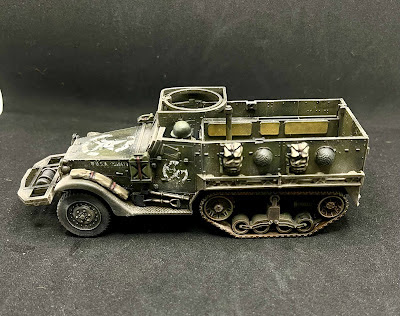
The second contribution to the Challenge last week is a US  M3 halftrack, the real workhorse of the Allied mechanized units in Europe (including several thousands supplied to the Soviet Union).


A solid and reliable APC, it saw action in Asia, Middle East and Latin America well into the 80s. It was also the main APC vehicle of the Spanish army, until being replaced by the M113 in the early 80s. Actually, you can see it featuring both on the Allied and  Axis sides in classical war movies films like Patton or the Battle of the Ardennes, filmed both in Spain with the support of our army.

This kit was acquired assembled second hand to one of my local club friends, and I'm unsure whether it is a Rubicon or a Warlord model. 

These two vehicles plus an extra bonus earned in one the Challenge Library rooms themes, added 60 points to muy personal scoring. I'm now at 200 points accumulated, or 50% of my 400 points target for the year.


Sunday, 7 January 2024

The Last Hundred Yards Reviewed: The Ultimate WWII Tactical Game

The Last Hundred Yards (LHY) is a series of tactical board wargames in a Second World War environment designed by Mike Denson and published by GMT Games. The LHY system has recently  become my number #1 tactical game of choice in detriment of Advanced Squad Leader (ASL). The LHY cover small mostly infantry-based skirmish actions at company/platoon level, with an innovative sequence of play resulting in fun, fast paced and furious engagements.

The terrain scale is 1 hex = 50 yards and the time-scale is variable, each "turn" or combat cycle representing between  2 and 5 minutes. Counters represents squads and sections (half squads), platoon leaders, support weapons (HMG/MMG, flamethrowers or light antitank weapons squads) and individual vehicles. 

Additionally there's a myriad of auxiliary counters to keep a record of activated units, fire effects (more on this later), heroic units, etc  as well as other counters representing minefields, foxholes, smoke of fortified positions among others.

The quality of production is high as usual in GMT: units counters are large  9/16 of an inch squares (3/4 of an inch for auxiliary counters) and maps are very nicely printed giving a sense of "3d" depth; the maps are generic geomorphic, double sided printed and can be arranged in almost infinite combinations. 

When compared to ASL, there are a few aspects that are worth taking into consideration:

The first is the length and complexity of rules: you got everything you need to play in a 34-pages long publication (the current rules book version 3.1). There's also a complementary "playbook" with extended illustrated examples of play of the different rules sections. And the scenarios (or "Missions" in LHY parlance) can include some (very few) special rules applicable to that particular situation. 

Second, the game is played using the historical orders of battle. The forces are organised in companies of three platoons, each led by a platoon commander and depicting three squads and potentially some support weapons. You can argue that these were "paper-strength" orbats; but missions (based on historical real engagements) take into consideration the real manpower of the units involved, adjusting the forces accordingly.

Third you play against the clock and the casualties. Missions may set some objectives, but you must accomplish the mission in a fixed timeframe (and time passed is variable in each turn) and not incurring excessive casualties. Unlike ASL for example, where you can win a scenario even with only one suqad left on the table, in LHY the depletion of your manpower counts against you. 

Finally, the very innovative game system based on an action/reaction chain of the players' units, reflecting the combat friction typically found in the battlefield.


Overview of the Playing System

How the system works? The sequence of play is structured in 7 phases or steps. 

Phase 1 (initiative) is to determine initiative rolling a dice and winning the side with the higher outcome. Note however that there is no full randomness. Usually the attacking side owns the initiative at the start and will have a positive DRM to the die roll in subsequent turns. 

Once initiative is resolved we entre into Phase 2 (activation), the nitty-gritty  of the system, based on an action-reaction chain. Activation is made by company and then by platoon within a company. Two platoons of the same active company  may coordinate actions with a die roll, but usually you go platoon by platoon  (To clarify: as the attacker, I declare that Able will be my active company; from there I activate platoon by platoon).

The selected platoon may undertake different possible actions: move, fire, withdraw, assault, call for mortars, recover from disruption or just stay put. Once the player declares the end of its platoon activations, the opposing player can react with the units that saw an action (i.e.: in LOS of an activated enemy undertaking an action). When the opposing player declares the end of the reaction, the player with the initiative may react to the enemy reactions or else conclude that platoon activation and activate a second platoon. Reactions do not need to be just shooting someone getting into LOS, but players can move units to get a position of advantage or to avoid being assaulted.

As you see the system creates a cascade of action/reaction moves. Interesting, shooting is not resolved automatically in this phase; therefore you decide your actions/reaction without any knowledge of what effect shooting had on the enemy unit. This adds another layer of friction to the game.

Introducing shooting, the system rewards proximity to the target which basically implies that little harm is made when shooting at three hexes or more. Fire effect is calculated as a "dice roll modifier" ranging from -4 to +3. The base number is the firepower of the unit shooting and the distance to the target, then adjusted by a list of modifiers (cover, hindrances, concealment, density of manpower in the target hex...) to get the final fire modifier.  

One example to illustrate the mechanics. 

  • A German rifle squad with a firepower of 1 and fire range of 10 hexes, shots at a US squad in a forest at 4 hexes distance. 
  • Crossing range (10) with the distance (4) in the Small Arms Fire Table, the German squad will have a base number of 0 (+1 for firepower less -1 modifier for distance).
  •  As the target unit is under cover of some woods, there's an additional -1 penalty to the shot, resulting a total fire modifier on -1 

 Note: should the Germans have fired at 3 hexes or closer, the modifier for distance for a 10 fire range squad would have been 0 and therefore the final fire modifier  would have been 0: +1 fire power + 0 distance modifier -1 for woods).

At this stage of phase 2, the target unit under fire will be marked with a "-1" Small Arms Fire Die Roll Modifier (SADRM) counter, but the actual effect of the fire will not be resolved yet. 

Once the active player concluded activating all the platoons and both players finished their respective reactions,  the play sequence moves to Phase 3 of Fire Resolution. As explained, the units under fire are marked in Phase 2 with the SADRM modifier. Firer rolls a 10-sided die, adds the modifier and compares the final result to the unit cohesion level: if lower, no effect; greater, the unit disrupts; if 10 or higher, the units suffers a casualty.

Assaults resolution is done in Phase 4 (after firing). Like shooting, assaults take place in Phase 2 as part of the units activations, but the effect of the melee is unknown until later in the sequence of play.

Phase 5 relates to mortars: now it's the time to extend fire missions called in the current turn; or to attempt  contacting the battery for the following turn. 

In Phase 6 (Time Lapse)  the active player rolls for time spent in the turn, which is variable between 2 and 5 minutes

And the final Phase 7 is a clean up phase in which players remove different game markers, the smoke counters placed in Phase 2, or place conceal markers on units out of LOS, etc

This is a nutshell how the system works, being very unique and distinctive compared to other tactical systems in the market. The rules book of course have many other chapters dealing with vehicles, anti-tank fire, airborne troops, special national characteristics (applicable to Russian and Japanese units), night fights, etc. 

If I have to summarise the game, the system rewards the player gaining and keeping the initiative. Having the initiative is in fact a key driver to win a game: as an attacker, getting the initiative allows great flexibility of action, with the defender only able react to your moves. If on the contrary, the defender gets the initiative, he'd be able to slow down the attacker, only having to decide how much time for space he's willing to trade.

Current product line and future releases

The LHY series currently has four game boxes (or "volumes") and one "mission pack" (set of scenarios)

Volume 1 ("The Last Hundred Yards") covered the US and the German army in the European Western Front during 1944 and 1945

Volume 2 ("Airborne Over Europe") introduced US and German paratroop units as well as British armour units (representing the XXX Corps assets for the US side Market Garden) 

Volume 3 ("The Solomon Islands") introduced the Japanese Imperial Army and the US Marines in Guadalcanal.

Volume 4 ("The Russian Front") very recently released (December 2023) covers the Eastern Front battles confronting the Red Army and the Germans between 1943 and 1945.

Mission Pack 1 provides some new maps and mission cards to play in the European Western Front.

In relation to future releases, the only confirmed addition to the series will be Volume 5 ("For King & Country"), introducing the British Forces in Western Europe during 1944 (Normandy and Market Garden). Vol 5 is currently in GMT's P500 page and likely to be released in late 2024

In a recent thread in BGG, Mike Denson announced he's taking a step back after the release of Volume 5  but will leave a committed and experienced team in place to ensure continuity of the system. After Vol 5 the team seems inclined to return to the Eastern Front battles but focused on the earlier war period (1941-43); no official release date yet, but sometime in 2025 likely.    

Convinced to jump-in? Some important considerations

So you have been convinced and want to play LHY? You must then consider the following:

Vol 1 and Vol 2 are core acquisitions that you need to have. These are needed to play the Russian Front volume, the Mission pack and the future British volume. 

Volume 3 (The Solomons) on the other hand, is a self-contained game; if your focus in the Pacific, don't need to buy the rest of the boxes. 

The designer is continuously updating the rules and support materials (playbook, tables)  with the the introduction of new armies and suggestions from players across the world. For that reason,  all the booklets and support tables coming in the different game boxes are outdated.

The GMT website posts the most recent versions of the rules, tables, etc. Check regularly for new version, to uploading and eventually printing. The latest version of the rules (as I'm writing this) is 3.1 The changes versus version 3.0 (included in the latest Russian Front game) are minimal but I suggest checking v 3.1and marking the amended paragraphs in the 3.0 printed booklet.

This also applies to the missions or scenarios: GMT has released last December the amended missions in downloadable pdf format for all the different volumes (including Russian Front!.. I wonder who is in charge of quality control at the firm). There's lots of small but nonetheless significant, changes that you should be aware of before playing any mission. 

Finally, if you haven't done it yet I strongly advise to sign in to the LHY's BGG website page. There you'll find a very active and supportive community of players, with tons of reviews, videos and other downloadable materials. My experience requesting clarifications and questions couldn't have been better indeed. Designer Mike Denson is also quite active in the forums.  


GBoH and LHY - Two of my favourite rules systems


Saturday, 6 January 2024

Painting Challenge report #1

A late start this year in the Annual Painting Challenge, Christmas holidays have been particularly busy with different family and friends gatherings.  In any case, my first post is already live (published on December 31st) and will eventually be the initial  part of a series dedicated to 2WW recce vehicles.


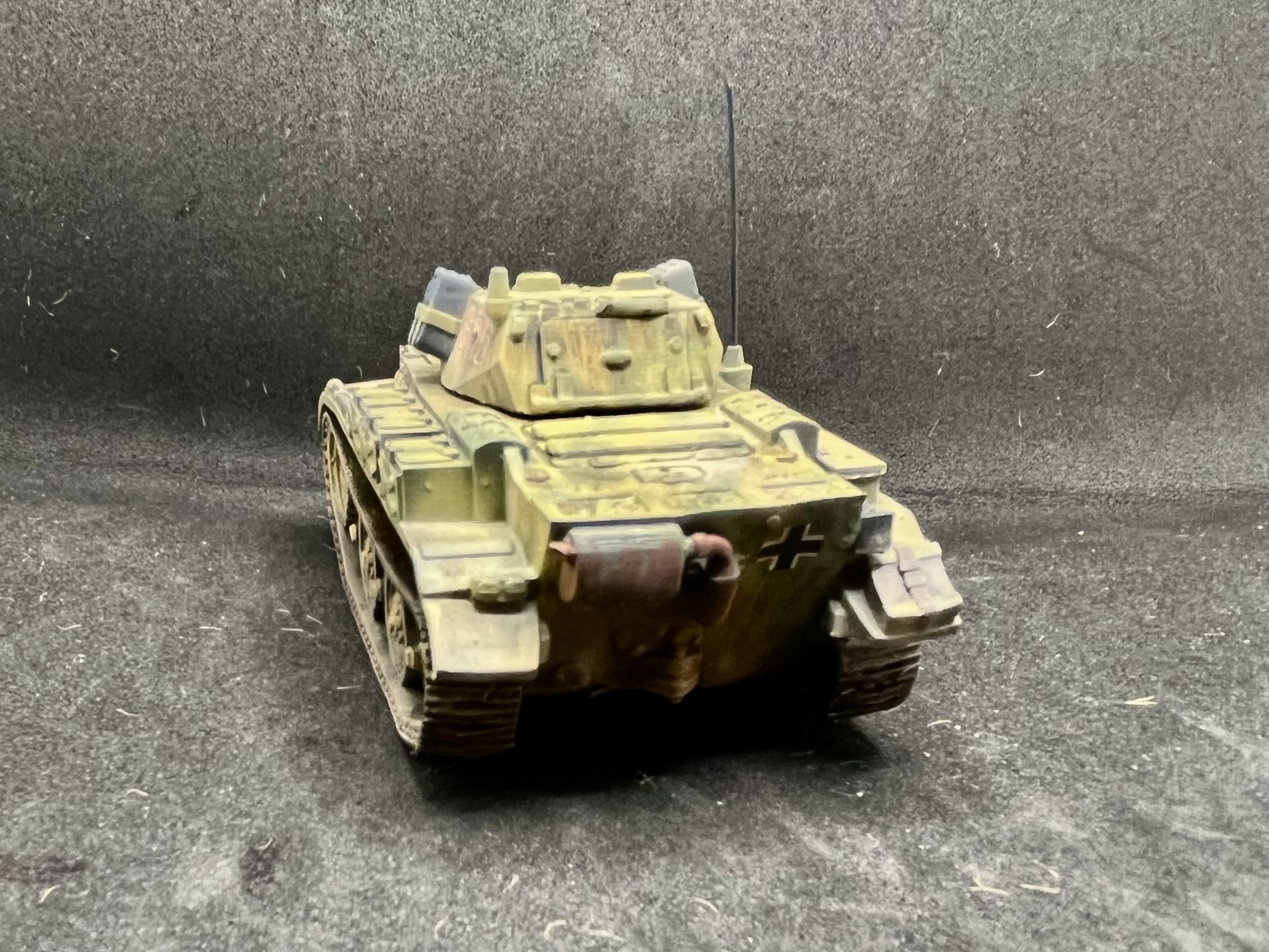
This is a German "Luchs" (or Lynx in Englsih) an evolution of the Panzer II that saw action from mid '43 in the recon units of the German divisions both in the Eastern and Western front. The production was limited to a total of 100 units (according to Wikipedia), which made sense cutting when Germany went into a defensive stance and shifter efforts to the large "cats".


This is a resin 3D printed model from the French company Eskice; this model in particular has a good design but the truth is that the brand is pretty irregular in the quality of their designs (the German Fallschirmjager for example are terrible) 

It was painted in a 2-colour (dark yellow + green) cammo scheme with a faded touch.


The model scored for the "New Acquisitions" section of this year's Challenge bonus pool (developed around the sections of a Public Library) and merited a total of 40 points (or 10% of my 400 points Challenge target in 2024).

Have a great 2024! 

Monday, 3 April 2023

What Makes Operation Market Garden so Appealing?

Territorio Grognard is arguably one of the best hobby podcasts in Spanish dedicated to board wargaming. In late February, they recorded an episode on Operation Market Garden (Sept 17th-27th, 1944), coinciding with the release of a Spanish edition of GMT's Mark Simonitch Holland '44 game by NAC Wargames.

Source: Imperial War Museum
 

I know Franjo one of the podcast producers and, as I am a fan of all things Market Garden, he contacted me to make a short intervention in this episode explaining what makes this operation so appealing to me. 

A simple question doesn't mean a simple answer. True,  Maket Garden is one of my favourite Second World War operations; but I never structured my thoughts on why. It may be related to the fact that in the summer of 1977, I was studying English in London and had the opportunity to watch A Bridge Too Far in the theaters there. But I got really hooked on the topic more recently, after listening to Nick Skinner (founder partner of Too Fat Lardies with Richard Clarke) disucssing the operation in one of the Oddcasts

But returning to the original question, I think we should put it in a different way: what doesn't have Market Garden to be one of the most appealing moments in the 2WW?

Firstly, it is a daring and very bold plan, aiming to cut the war short. Intriguingly, the operation was proposed by Field Marshal Montgomery himself, usually considered (wrongly!?) one the most cautious Allied commanders.

Second, it is one if not the most, epic operation of the whole war. A thrust into Germany to build a bridgehead over the Rhine, outflanking the main defence lines at the Ruhr area ... and to Berlin and beyond.  

Source: Wikipedia

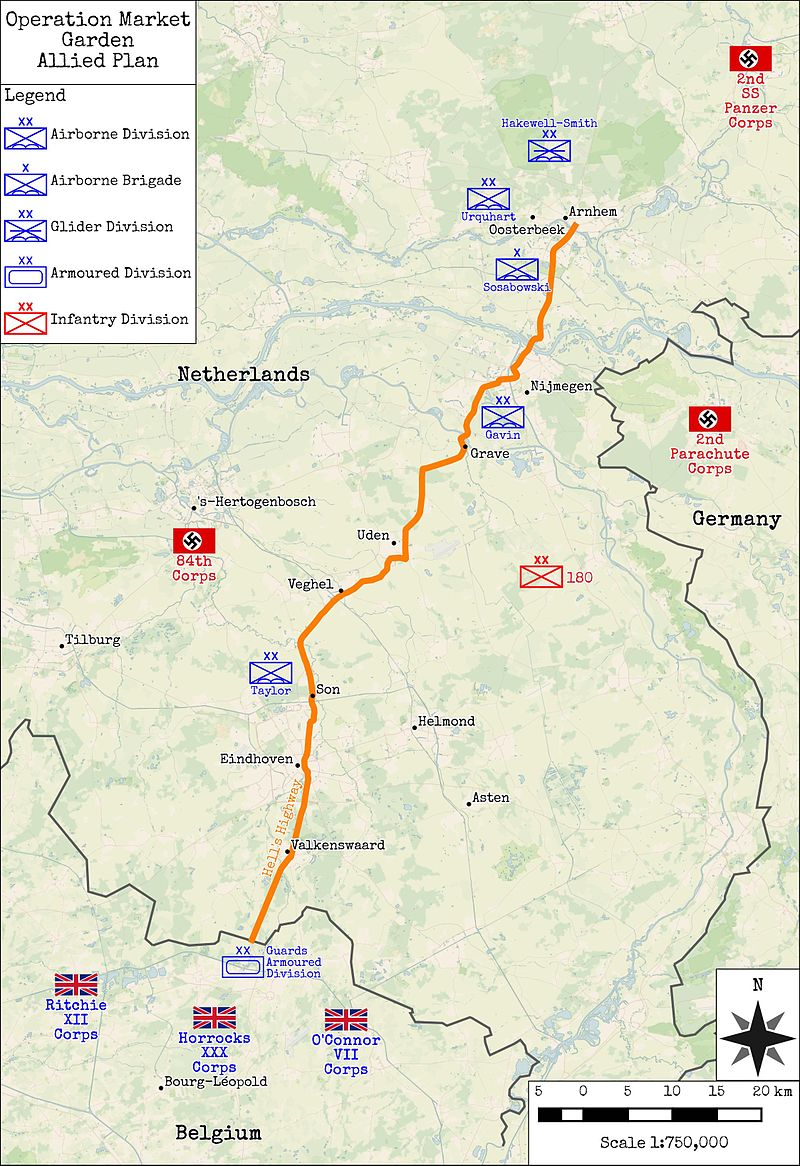
For this purpose, three airborne divisions (US 101st and 82nd, and British 1st) would jump in a corridor over 100km long behind the enemy lines, while a powerful armoured force (The British XXX Corps of the 21st Army Group) would advance and connect the three landing zones. 

The task of the three airborne divisions was to capture and defend nine critical bridges, spanning over six major riveras and canals in The Netherlands, until being relieved by the land forces.

For a wargamer, Operation Market Garden opens a wide array of gaming opportunities at different levels, from high strategic-operational levels to very low tactical encounters. 

Boardgames are probably best suited for the former. Historically, the airborne landings caught the Germans by surprise and were a total success. 

However, these prompted a fast and violent reaction, completely unexpected by the Allied planners, who thought the Germans on the ground were just second rate units and demoralised beyond recovery.

The Germans counterattacks threatening the XXX Corps line of supply along route 69 (the famous "Hell's Highway"), and the fighting to control some of the key bridges along the route are a fantastic context for operational-level games (more on this later). In parallel to the XXX Corps thrust, the US airborne units must simultaneously take and control bridges, defend the landing zones (needed to bring supplies and reinforcements) and retain control of route 69.

British landing and Attacking Routes
The 1st British Airborne Division  jumped at the tipping point of the Market Garden plan. It went almost immediately on the defensive after landing due to the quick reaction of the local scattered German forces, initially forming around the so-called Kampfgruppe Krafft; but later in a more organised way around the assets of two SS divisions (9th and 10th) refitting in the area .  

Therefore, a high level game would see lots of action around the supply routes as the German pressure increases in the post-landing reaction, attacking even at very unfavourable odds. Allied players will have to assume two opposite roles: on the offensive in the south with the armoured corps to link with the different airborne divisions; and defensive in the north to defend any initial gains made in the Arnhem/Oosterbeek area. And players (or group of players) on both sides would have to run against the clock!

The possibilities for low level games using miniatures are also endless. Most wargamers have focused mainly in the desperate battles of the British Airborne Division in Arnhem and surroundings (see for example the event last October at the Oosterbeek Museum organized by TooFatLardies). 

While epic and heroic, there are many other alternative scenarios to be played at the scale of battalion or platoon with US Airborne division or with detachments of the XXX Corps: attacks and counterattacks around key bridges; contested epic river crossings; urban fighting (Nijmegen for example); ambush actions on British armoured vanguards... Also noteworthy the variety of army units and motorised hardware used by the Germans to create very attractive visual displays on the gaming tables.

Wargaming Market Garden

In the podcast commented above, I was also put a couple of follow up questions: my favourite wargames to play the operation and reading recommendations.

As for wargaming, my first time recreating market garden was with Storm over Arnhem (SOA), a venerable and iconic game released by the defunct Avalon Hill in the 1980s. This was one (if not the first) to use the area-impulse mechanism instead of the traditional hex-grid map, a revolutionary change at the time. As the title suggests, the game is focused on the British Airborne Division's desperate fight for the bridge at the Arnhem-Oosterbeek area. 

The two more recent games I have been playing cover Market Garden fully at operational level: Monty's Gamble and Holland '44

Monty's Gamble fom Multi Man Publishing is another area impulse based game but with a more sophisticated level of development than SOA.  I own the second edition released in 2019 and still widely available in hobby shops. The rules are reasonably simple to learn and the game is highly replayable. 


Monty's Gamble Board

 
SOA Board

Holland '44 form the GMT stable and designed by Mark Simonitch, is my number #1 game for Market Garden. Although more complex than Monty's Gamble, it is fairly accesible for anyone with some track record in playing wargames (but I wouldn't recommend to get anyone introduced to the hobby).

 The game is a very realistic portray of the operation, offering both Allied and Germans opportunities to win based on the different victory conditions. I have played it several times; the game helps to understand the tough choices of the Allied forces (racing to the north but forced to keep the lines of supply open at the same time), and the problems faced to the Germans receiving piecemeal but increasingly larger reinforcements to defeat the Allies.

The recently released Spanish version of the game by NAC Wargames is a work of love: incredible high-quality components (pre-cut counters,  mounted and paper maps, support tables...), a new scenario published in C3i and a new revised and upgraded edited version of the rules. In fact (confession time) I sold my original GMT English copy to acquire the new NAC edition after watching an unboxing video...and  no regrets so far.

On the miniature gaming side (see my previous post discussing board vs miniature gaming), Chain of Command is my best option to play skirmish level actions, as explained before. Too Fat Lardies co-founder Nick Skinner has been working and testing extensively a supplement or handbook focused on Market Garden, that we expect to see released sometime in 2023. 


Notably, TFL organised a game day at the Airborne Museum in Oosterbeek in October 2022 and I have just heard the news in a recent Oddcast that a new event is scheduled at the museum premises by the end of October 2023.

Operation Market Garden: What to read?


Cornelius Ryan "A Bridge Too Far" is the early, and now classical work on Operation market garden, that supported the script of the epic film with the same title.

Unfortunately, the book (unlike the film) has not aged well, and some key wrong ideas and facts about the operation have become undisputed myths over time.

More modern works and research are removing some of these myths or questioning decisions taken by some Allied leaders on the ground, like Gavin of the US 82nd Airborne.

For an overview of the whole operation, I recommend  "The Battle for the Bridges" by Anthony Beevor, released in 2018. Note: I'm not a devoted fan of this military historian and has found his books to be quite irregular. 

But this is a good book to start, despite that some of the myths commented above still survive in his work (for example, the famous "stop to brew tea" of the Guards tanks in Nijmegen after taking the bridge over the Waal).

Robin Neilland's "The Battle for the Rhine 1944" covers the battles from the Normandy breakouts to the Ardennes, and helps put in context the two landmark operations of this period (Market Garden and Watch Am Rhine). This late British historian reviews in depth and makes a strong case in favour of the odds of success of Market Garden.

I have two favourite books that usually I read every year. The first is Martin Middlebrook's "Arnhem the Airborne Battle"  dealing with the fight of the British Airborne Division. It is a book rich in details, using first hand views based on veterans' personal letters, diaries and interviews,  and extremely well written and documented.

The second is focused on the other side of the hill: Robert Kershaw's "It Never Snows in September". This book tells the story from the German point of view and it is the perfect complement when you read Middlebrook's for example. Also extremely well written and documented, provides a detail review on how and why the German reacted so fast to the landings, as well as a critical view of some of the Allied actions and decisions. A must-have.   

Finally, I'd like to bring your attention to a short, widely unknown but intriguing and interesting research study written by Dutch military historian R.G. Poulussen and titled "Lost at Nijmegen: A Rethink on Operation Market Garden".

As the title suggest, the author's argue that Market Garden's main fault was Gavin's procrastinating to take and secure the bridges over the Waal river. The XXX Corps' armoured spear points actually arrived to Nijmegen within schedule despite the problems faced earlier in the operation, only to find the bridges still under German control. 

This had a twofold impact: it forced the British units allocated to reach Arnhem to fight a battle to control the bridges; and for the Germans, once Frost's resistance crumbled at the Arnhem bridge, the delay allowed them to fortify and reinforce the section between Nijmegen and Arnhem (The "Island") forfeiting any possibility of the Allies to reach and capture the bridge over the Rhine.


Thank you for reading this. Do you have any special operation or battle close to your heart? Feel free to leave your comments  


Wednesday, 15 March 2023

Painting Challenge Report #12

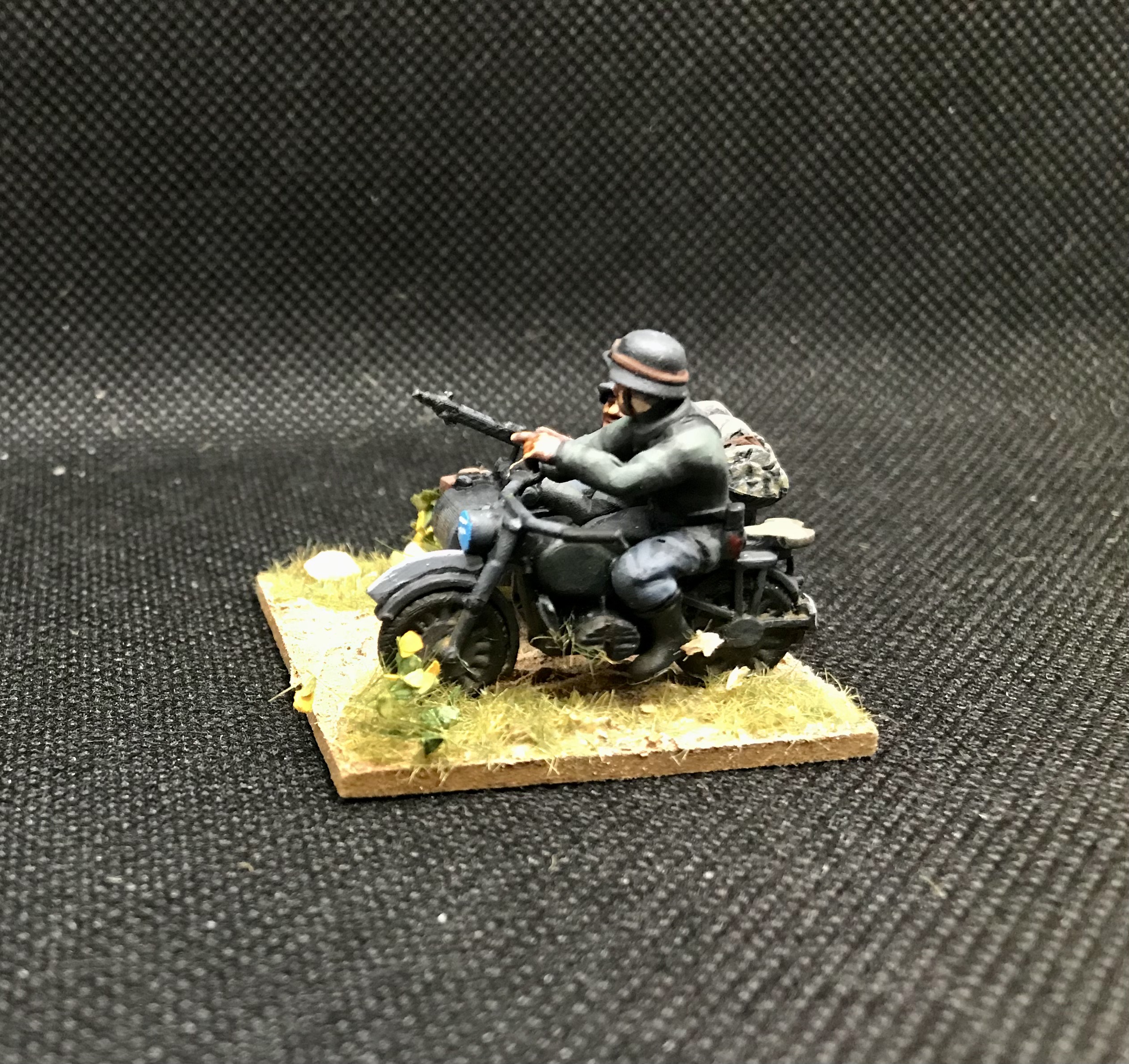
All good things must end, and the Painting Challenge too. The last three months went away incredibly fast, an coinciding with the start of Spring the Challenge concludes. My latest Tuesday submission is a second German motorbike with sidecar (an Eskice brand 3d printed model) and a few German Fallschirmjager from Warlord in the early war jump suit.


The veteran wargamers looking at the photos may have realised a terrible and unforgivable historical mistake in one of the German paratroopers models: one is carrying a MG42 LMG model!!!  These only went into service from mid to late 1943, unlikely any jumped into France or Crete 

 The Warlord plastic German paratroopers box mixes both early and late war models. When I assembled the models, I classified in two different trays,  but it seems that I mistakenly put this mini in the wrong tray, only realizing only when finished painting and basing the model. 

 My score after this submission is 689 points, or just an inch away from the 700 points target set for this year's Challenge. Luckily, this weekend will have a  "free fire" slot, in which challengers shall be allowed to post at any time until Sunday at midnight in Canada. Already working on some late minute contrbutions to be posted over the weekend.    

Tuesday, 7 March 2023

Painting Challenge Report # 11

This week my paint work slowed drmatically for many different reasons, and I could only finish one motorbike with sidecar model for my motorized early war German unit.


My initial plan was to have the three Eskice models painted this week, but it was derailed because I procrastinated for too lomng and also because I forgot to print the third model (unfortunately, the printer is stored in my parents summer house, that will remain shut down until Spring)


I could only add 20 points to the scoring this week. The accumulated figure now is 654 points. I have  exactly two week to hit the 700 points target mark. Except for some unexpected event, I hope to reach it in time. 

Wednesday, 1 March 2023

Painting Challenge Report #10

As commented last week, I'm taking a few weeks of the Challenge now to break away from my core Saga projects and capture some bonus points from the Challenge Studios, painting some minis on the side. Last week it was all fantasy and the Lord of the Rings, this week is Second World War.

I have an old German early war project for Chain of Command half finished. It was initially planned for the 2019 Challenge but other projects stepped in the way (ah! the wargame butterfly inside of me). Having in 2022 jumped into the 3D printing activity, the project was rekindled last summer after printing a set of German motorbike riders from Eskice Miniatures.


These are going to work as a motorized infantry squad support unit or as part of a recon group. I still have pending a couple of motorbikes with sidecars that will provide the LMG tgeams to the squads. 


Painting filed grey and panzaerr grey is not very exciting but it is fast; and despite being very dull colours, I'm noy unhappy with the final results.


After this week submission, my accumulated scoring has reached 634 points or 91% of my 700 points target. With a little bit of effort I may reach the finish line next week, let's now pray that any unexpected professional o personal committments don't come in the way.  


Monday, 20 February 2023

The Day of Battle: The War in Sicily and Italy 1943-44 by Rick Atkinson

As commented in a previous post, this year I planned to do some research and to read on the Italian Campaign during the Second World War. I firstly reviewed James Holland's Sicily 1943 book and in this post I'll do the same with a second book:  Roy Rick Atkinson's The Day of Battle.

The book is part two of The Liberation Trilogy covering the Western Front campaigns:  Torch and Tunisia in 1942/43, the Italian front 1943-44; and the Normandy campaign until the final surrender in May 45.

The Day of Battle focuses on Sicily and Italy until the fall of Rome. Therefore it covers Operation Husky, Salerno, Montecassino, Rome and the battles to break the different German defensive lines across the south half of the Italic Peninsula.  

The campaign  had a promising start with the Sicily invasion (Operation Husky) as described in a previous blog post commenting James Holland's book.

However, the following operations were mired with a lot of problems, including the differing strategic views of the main Allied partners about where to start the conquest of Continental Europe (the Americans were committed to a full effort in France, the British to the Mediterranean). This differeing views resulted in total a lack of clarity of the main objectives and golas for the Allied forces arriving to Italy's continental soil.

Add to this an ill-planned landing operation at Salerno (operation Avalanche in September 1943) in which the Allied army was in the verge of being defeated and to cnduct a potentially catastrophic reembarking operation; the great defending opportunities offered to the  Germans by the terrain (numerous river lines, mountainous landscape unsuitable for amour), lack of good metalled roads (or just lack of roads) and finally the terrible weather from October onwards.

Source: Wikipedia


The Allied forces in Italy were also continously shrinked, as many divisions were transfered to England for Overlord (initially planned for April/May 44) in addition to the natural manpower wastage caused by the campaign and the weather. 

At the end of the day, the Germans fought a series of successful delaying actions, retreating from one fortified line to another, using the rivers crossing east-west and finally consolidating an d area in the north of Italy, occupied until the German surrender in May 1945.

The Book

The Day of Battle is another thick 850 pages book of the trilogy. It covers the period between the end of the Tunis Campaign, Husky and then all the way to the liberation of Rome.

But to make the story short, I'll start by the end: I  did not like the book and hinestly I cannot recommend it.

For a start, the book could have been 30% (+/-)  shorter by just the author being more focused. He spent a lot of space rambling about superflous stories, many times unconnected with the main topic. In addition, he adds all types of small details in the descriptions and instead of making them more realistic and credible, the achieve the opposite: I got bored and many times impatient to know where the author is heading to.       

Atkinson also loves gossip, a lot actually: Churchill and Roosevelt meets? You'll learn the detailed menus, where many of the dishes were flown from,  the color of the pyjamas used by the British premier, a thorough description of how much Churchill liked to take baths or the amount (and type) of drinks consumed in some these wild parties. 

Montgomery crosses the Messina Strait and meets the press? You'll learn that he sipped three coffees with cookies while addressing the journalists. And also that Monty always travelled with his collection of parakeets and canaries in cages.

When describing the operations, Atkinson goes in many places the "James Holland" way: using the personal "voice" of the people involved and from there build up the chapter to describe the actions at a higher altitude. However I thinks he fails in the way he "zooms out" the action, but also in lacking to provide enough good operational detail.

And finally, the book (the electronic version) lacks any maps (!!) I have checked and the printed edition actually DO have maps, so this is negligence on the part of the editor, not the author. In any case this forcved me to navigate continously in Google maps, not the most efficient solution at times specially if reading offline.

In summary, I had a very frustrating experience with this book and the author. I honestly did not enjoyed the reading, skipping significant portions that did not provide any real added value. I did klearn  

What's Next?

I'll jump now to  James Holland's Italy's Sorrow: A Year of War 1944-45 to cover the final lap of the Italian operations and with this I will conclude my readings on the campaign, at least for the moment. 

To note that over the past recent weeks, James Holland has released a few episodes on Italy 1943-44 in his co-hosted podcast channel "We have ways to Make you Talk". It looks like this will be the topic of his his next book; and I guess it will be released by the summer (no later) ready for the annual We Have Ways festival in September, dedicated this year to "1943" a decisive year in the Second World War.   


Monday, 16 January 2023

Sicily '43 by James Holland

After many decades reading about the Second World War, I realized that I had some major gaps in other many "secondary" (or not) theaters, like for example the Italian campaign; or in main War theaters like the Pacific (covered last year with the excellent trilogy written by Ian W. Toll); or most of the Eastern Front battles.

Following a visit to Montecassino and Anzio in late April 2022, I made a firm self-committment to start filling those gaps inmediately. Over the late summer and the autumn 2022, I focused my attention in the "other" 1944 Western Europe battles (= excluding Normandy, Arnhem and The Ardennes) and in the 1945 campaign. 

Not an easy task, as surprisingly there are not many published works. Luckily I found a couple of superb books to fill this gap:  the late Robin Neillands´ "The Battle for the Rhine 1944", covering from just after the Falaise pocket in August 1944 to the end of The Bulge in very early 1945.

And followed byPeter Caddick-Adams' 1945: Victory in The West  which seamlessly continued the narrative at the point where Neillands book concluded (just after The Ardennes) and until the capitulation of Nazi Germany in May 1945.

For 2023 I planned to research two very different topics: the 1943-45 Italian Campaign and the whole of the Eastern Front (from Barbarossa to Berlin). Being undecided about which I should  go first, I arranged a poll in Twitter, and (surprisingly ) the majority opted for the Italian Campaign (3 to 1). 

My reading open shot for this theater has been  Sicily '43: The First Assault on Fortress Europe  written by James Holland. He's one of may favorite military history writers of whom I had already read his two tomes on the War in the West, Normandy and Arnhem.


Brief summary of the campaign

The Sicily campaign extended between July 9th and August 17th 1943 and was the Allies' first step into Continental Western Europe. The operation had four distinctives phases: 

1. Before the invasion, the aerial campaign in Sicily and South Italy to gain control the skies before the actual landings. This campaign was a complete success. Bombers protected by fighter screens flying from Malta and North Africa, rendered destroyed the Axis airfields and many of the enemy planes operating in the island, forcing the Italian and German air forces to pull back to continental Italy and Sardinia. For most of the campaign, Allied forces enjoyed full air supremacy.

2. The landings and  consolidation of the beachheads: previous to the major landings, commando and US Ranger forces successfully crippled many of the critical coastal defences; the naval and air bombadment during the sea assault made the rest. Unlike in Normandy almost a year later, landings were generally very sucessful and with little effective opposition. The major Allied disaster in this phase were the airborne operation, very badly executed due to the inexperience of the transport crews.

3. The fight inland. After a successful landing, the Germans and Italians counterattacked aiming to force a reembarking of the Allied troops. With the exception of the attack led by the Hermann Goering division in the US sector at Gela, these counterattacks were ineffective and costly to the Axis forces. 

With the Italian resistance weakening, the Germans took full control of the island operations. Reinforcements were sent across Messina and the units pulled back to a main defence line around Mount Etna, a rough and easily defendible area with few access roads. The Allied advance slowed in that difficult terraind and casualties increased significantly.

Source: Wikipedia
 

4. Evacuation: by the end of July, and with Mussolini ousted, the German command saw no reason to continue in the Island and planned an evacuation through the Messina Strait. The goal was to avoid another "Tunisgrad" and to save as many troops and weapons as possible. The evacuation was successfully executed between August 11th and 17th. Despite the overwhelming Allied air and naval superiority, a concentration of naval and flak guns in the narrrow strait made impossible for the Allies to interfere with the evacuation to the continent.

The Book

Sicily 43 is a thick 600 pages detailed book, with abundance of maps, photos and annexes. 

This books fills a major publishing gap around this operation. As in other previous works, Holland relied on diaries, interviews, letters and other materilas from the people involved, not only combatants but also civilians victims of the terrible consequences of the war.

The structure of each chapter is similar: start with "the voice" of an individual witness involved in the specific event of the chapter and from there zooming out to have a panoramic view of the situation. The using these personal voices helps the reader to get inmersed into the situation, sometimes in a very dramatic way: the Italian officer that found a naked Italian young woman on her bed killed by the shrapnel of Allied naval guns while sleeping; or the frequent comments on the thirst, flies and stench of dead affecting both sides.

The book is written in a very engaging style. In addition, chapters have the right length for me (around 15 pages) perfect to spend 20 minutes reading in bed before sleeping. The number of maps is right and the level of detail enough to follow the narrative, including all the main locations and geographical features mentioned in each chapter.

There is a lot of useful material in the book for wargamers, given the detailed description made of some of the encounters. On a more general level, there are three issues that attracted my attention specially:

The technical weakness of the Tiger I tanks. The HG division had a battalion with 17 of these monsters and almost all were lost due to techncial glitches or breakdowns. The lack of a transport (rail) forced the tanks to move via dusty roads to the front line, losing many in the way due to engine failures (one even caught fire in a retreat, blocking the road to the rest of the columns)

The myth of the race to Messina. Using available documentation, the author busts this long-time standing myth (nurtured with the Patton film) about the competition between the American commander and Montgomery to be the first in the city. Neither Alexander (the C-in-C)  directed or favoured the  in any way the English Army corps, nor Monty obstructed the communication lines to gain an advantage over Patton's forces.

The disastrous execution of the airborne operations. Firstly, these troops were superbly trained but nobody seemed to worry about putting on equal foot of excellency the transport crews in charge of taking the paratroopers to their objectives. Second, despite the disaster with the first wave (night jump with inexperienced air crews), the Allied command attempted a second wave that was even worse: where to the the previously mentioned factors, you have to add that the element of surprise was already lost and the enemy was ready to confront an airborne assault; and on top of that, the route to the LZs crossed the area of the Allied fleet, with many losses caused by friendly AA fire.

The disaster of the airborne contrast with the effeciency (both in terms of resultsaand limited casualties) of the raids executed by the Rangers and British commandoes  attracking their objectives landing from the sea. The Allied command seems not to have taken stock or learned almost mothing in following operations.

And a final note: did the Italian-American maffia have a rol in the massive surrendering of Italian tropps in the island? There is an interesting tale in the book of yellow pennants in Sherman tanks, maffia leaders and active OSS personnel but without a clear conclusion.  

Conclusions

Sicily was a clear Allied victory, controlling the island in 5 weeks albeit with a high cost in casualties. It is estimated that Allied suffered 24,000 casualties of which 4,800 were KIA. German forces suffered around 28,000 casualties of which 4,300 were KIA and around 10,000 POWs. Italians had the highest casualties, 37,000 in total of which 4,800 were KIA and the rest wounded.   

Strategically, Italy was ousted  the Axis forces lossing several hundreds of thousands of men from the Italian army as a result (only in Sicily surrendered over 100,000 Italians); German divisions had to be transferred from the Eastern front and from Western Europe to defend the South; and logistically speaking the operation was a feat and a success for the Allies.

Was it a complete victory? To some extent the victory was tarnished by the ability of the German army to pull out in the face of overwhelming odds, extracting close to 60,00 men and many thousands of vehicles, guns and tanks that were later used in the defensive battles of the Italian campaign, until the unconditional surrender in May 1945.


What's next?

My next goal is  the campaign in the Italian penninsula, and I have two books in sight:

1. Rick Atkinson's The Day of Battle: The War is Sicily and Italy 1943-1944  (second book of the Liberation trilogy).   On this I have second thoughts, as I liked the book on Torch and Tunisia (An Army at Dawn) but didn't like much the third dealing with Normandy to Germany (The Guns of Last Light) 

2. James Holland's Italy's Sorrow: A Year of War 1944-45. The main drawbak of this book is covering the period from Montecassino to the end of the war, thefore Salerno, the drive to Rome and Anzio are excluded. On the positive side,  I already covered Cassino/Anzio with  Peter Caddick-Adams book, used to prepare my battlefield visit on April 2022.

Other potential interesting readings, but exclusively focused on the Canadian armies, are the excellent series written byCanadian military hostrian Mark Zuehlke: Ortona, Forgotten Victory, The Gothic Line, The Liri Valley, and The River Battles.

----------------------------------------------

You can follow James Holland in his website, Twitter account or by listening to his podcast channel "We have ways to Make you Talk" in collaboration with Al Murray.