This may come as a surprise to some of my followers: a post about a fantasy game? Were you not a diehard historical gamer?

You, playing a fantasy game??
Well yes and no. As commented in a previous post titled "Board Games vs Miniature Wargames", my wargamer CV shows some early assignments in fantasy-related gaming (both, RPG with D&D and massive battles with Warhammer Fantasy).
True, for several decades now I have only played historical games and mainly miniatures-based. But in my recent come back to board gaming, I was attracted to a game called "The War of the Ring", after watching the gameplay series on Youtube made by Agustí Barrio (Spain's #1 wargames influencer!).
Being also a Tolkien fan did not help me to jump into that wagon. And with Father's Day in Spain taking place on March 19th, I just "nudged" my family to swap the traditional tie-and-socks pack for a copy of the game instead.
 |
| Box size comparison: War of Ring vs standard board game |
The second edition of the game was released in Spanish by Devir; a very high quality box (the one I own now) with a content that is just... WOW!: a beautifully designed hardboard map; a set of 124 large (12 cm long) events cards; and over 200 minis depicting the different armies from the Shadow Alliance (Orthanc, Mordor and the North & East peoples) and the Free Peoples (Rohan Gondor, Elves and Dwarves Kingdoms, and the Dunedain); and individual models of the main characters (all the Fellowship members, Gollum, the Witch King, Saruman the White, Mouth of Sauron and the nine Nazgul).
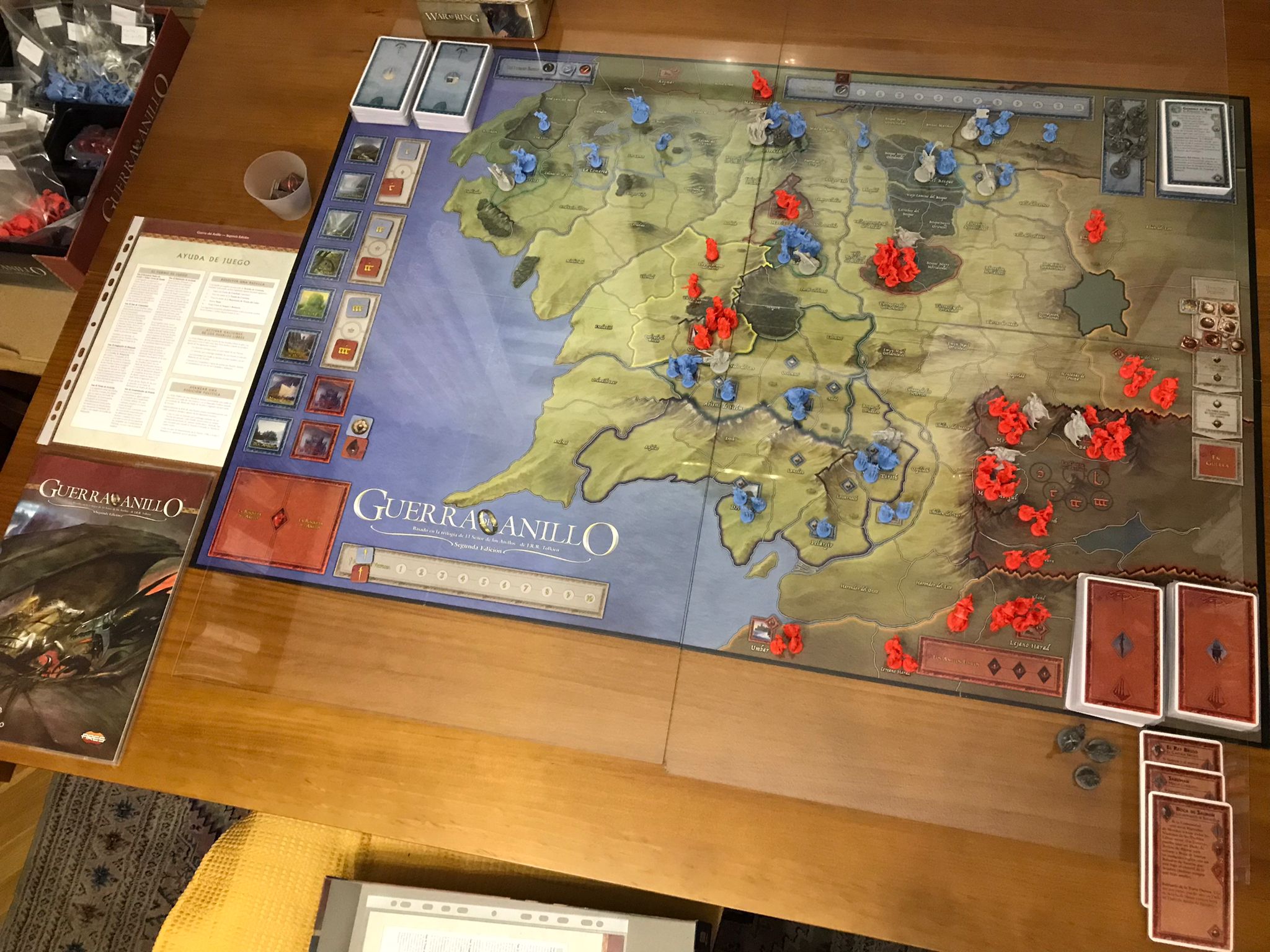 |
| Game display at turn 1: observe reds superiority (Shadow) vs blues (Free Peoples) |
In addition to the topic covered by this game, the rules design attracted all my attention. At high level, the Free Peoples players main objective is to destroy the Ring by taking it to Mount of Doom in Mordor, while resisting the military tide of Shadow Alliance. At the other side of the Hills, the players controlling the Shadow Alliance must fight, defeat and conquer the Free lands to achieve victory, the Ring playing only a secondary role (albeit still relevant) in the Shadow's plans.
 |
| Witch King, Saruman and Mouth of Sauron |
In this sense the game is very thematic and fits nicely with the Lord of the Rings book trilogy narrative: the Free Peoples start the game divided, un-alerted, and hardly aware of the threat rising in the East. Only Elves know about the Ring (the Fellowship starts the game at Rivendell) and are getting prepared for war.
As the Shadow grows and the threat become obvious, the Free Peoples must rush to build their armies... but maybe too late to defeat the might of the Shadow forces. Their only hope to win is buying time for Frodo and the Fellowship to reach Mount Doom and destroy the Ring.
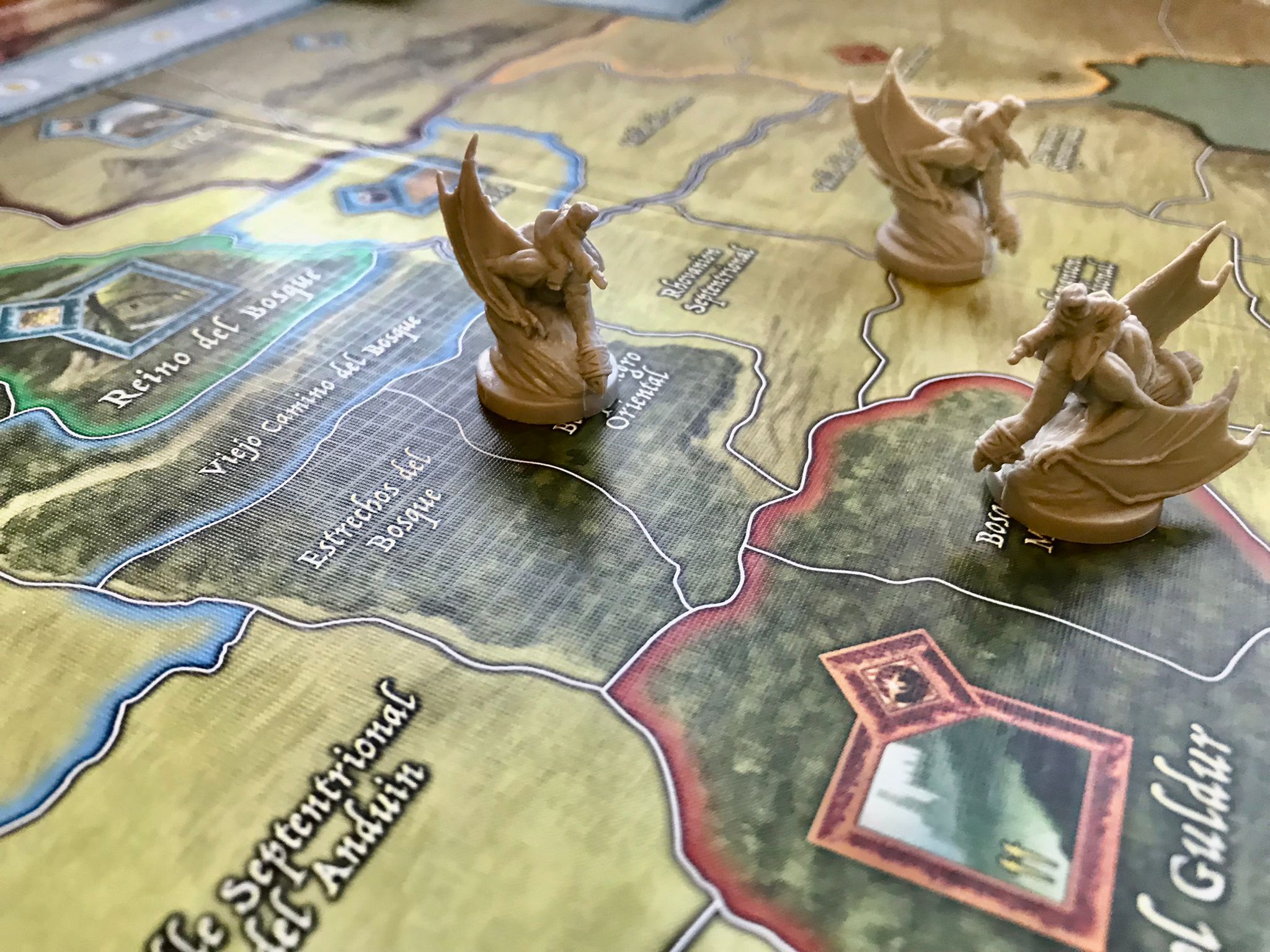 |
| Nazgul! Nazgul! |
The Shadow starts the game with significant military forces and very close to reach a "state of war" level. Mighty armies of Orcs, Uruk Hais and men form the North & East will unleash shortly after the game starts, and will overrun Minas Tirith, Edoras, Hemlm's Deep and the main Elven and Dwarven realms.
How the game works?
Without entering into much detail, this is a game driven by a combination of action dice rolls and a hand of cards.
Dice have special symbols, and allow players to do different things: play event cards, move characters, move armies, lead attacks, move factions along a political track towards a "State of War" status (needed to recruit troops) or recruit armies.
.jpeg) |
| Action Dice for Free Peoples (blue) and The Shadow (red) |
Cards can be played either as "events" of many types; or in during the battle segment affecting in different way the combat die rolls.
.jpeg) |
| Add-on: A nice tin box to store the game cards |
As commented before, for the Free World player is critical to race towards Mordor and Mount Doom. The designers have a created a very elegant and thematic mechanism to manage the Fellowship, and it's worth explaining with some detail:
In the case of the Free Peoples, a "sword" die roll allows moving the Fellowships towards Mordor and Mount Doom. The progress of the fellowship is shown in a track but only when discovered by the Shadow or declared by the Free Peoples player, it is placed in its actual position on the map.
 |
| Gollum and the Ring Bearers at Mount Doom |
The Shadow player can allocate a number of action dice to detect the Fellowship each time it moves. If successfully detected, he will randomly select a chit from a bag. The chits may force openly revealing the Fellowships location and/or taking a number of hits (from zero to three) on it.
How do you absorb these hits? Two different ways: either killing a member of the Fellowship (chosen randomly); or suffering "corruption points". If the Fellowship accumulates 12 corruption points, then Frodo have failed to complete the mission and the Ring is now controlled by Sauron... game over.
There are ways to reduce the Fellowship's balance of accumulated corruption points, either through card events, or revealing the Fellowship in a realm of the Free Peoples at the end of each turn. The Free People player's dilemma is to decide between the corruption level he's willing to take, the speed toward Mordor (the fastest it goes, the easiest to be discovered) and how many companions he's willing to sacrifice on the way.
Finally, the Shadow can use one or more Nazguls to track the Fellowship, improving the chances of being discovered each time it moves.
Once in Mordor and climbing Mount Doom, the Fellowship runs much higher odds of being discovered and therefore "corrupted"; again a very thematic part of the game, reflecting Frodo's mental and physical exhaustion in the final lap of the trip. Noteworthy, Gollum leads the Fellowship once inside Mordor, providing some benefits to the Ring bearer.
.jpeg) |
| The Fellowship Move and Corruption Track |
While the central drama with the Fellowship unfolds, the Free Peoples player must buy time and defend the key locations in the map from the mighty armies of the Shadow. To achieve a military victory is almost impossible, as the Shadow have infinite resources and the Free Peoples player only a limited number of assets: Free Peoples battle casualties are lost for the rest of the game, while the Shadow's are recycled and can return as reinforcements.
Finally, there is room also to play with the main characters during the game. For example, Aragorn starts the game as "Strider"; but if he leaves the Fellowship and emerges in Gondor, he'll declare as Isildur's heir and become "Aragorn", adding some special features for the Free Peoples players. Moving Aragorn to Helm's Deep or Minas Tirith substantially improves the defensive options of these two strongholds, denying the Shadow a significant number of victory points.
.jpeg) |
| The Fellowship |
Gandalf on the other hand, starts the game leading the Fellowship as "Gandalf the Grey". If he dies during the game, it can reappear as "Gandalf the White" with some special features as well.
 |
| Main Characters Cards |
First impressions of the game
I have played so far a solo game, and a couple games in my local club. These games were great: tense, funny, thematic. And it can be replayed as many times as you want: each side's the card deck helds 48 cards; and in the games that I have played so far we have never run out of cards.
My initial advice to a Shadow player is to early invest in building large armies (Sauron is a factory of mass-producing Ururk Hais) and therefore move quickly through the political track towards the "State of War" position (players can only recruit troops once reaching that box). Hit early and hit hard to accumulate as many victory points as possible.
 |
| Political Tracker |
Best strategy advice for the Free Peoples players: use as many event cards as possible in your hand to recruit troops, keeping a close eye on who (Suaron or Saruman) is likely to strike first:
Although Saruman shares border with Rohan, the wizard does not start the game deployed, he needs to be brought on the table.
Sauron on the other hand, starts with a fragmented army in diffrent locations within Mordor. Before striking Gondor, he needs to concentrate and reinforce his forces.
This can provide some initial relief to the Free Peoples player. But be wary, because a good hand of cards on either side can substantially change the opening moves of the players.
Wrapping up
The War of the Ring is great game in all dimensions: it perfectly captures the atmosphere of Tolkien's Lor fo The ring narrative; its extremely well balanced and both sides have options to win the game (albeit using different strategies, as commented above); the rules are complex-free and easy to play almost from the start; it is fun to play; and, finally, thanks to the dice-card driven engine, it is highly replayable. Cannot recommend more.


