Territorio Grognard is arguably one of the best hobby podcasts in Spanish dedicated to board wargaming. In late February, they recorded an episode on Operation Market Garden (Sept 17th-27th, 1944), coinciding with the release of a Spanish edition of GMT's Mark Simonitch Holland '44 game by NAC Wargames.
 |
| Source: Imperial War Museum |
I know Franjo one of the podcast producers and, as I am a fan of all things Market Garden, he contacted me to make a short intervention in this episode explaining what makes this operation so appealing to me.
A simple question doesn't mean a simple answer. True, Maket Garden is one of my favourite Second World War operations; but I never structured my thoughts on why. It may be related to the fact that in the summer of 1977, I was studying English in London and had the opportunity to watch A Bridge Too Far in the theaters there. But I got really hooked on the topic more recently, after listening to Nick Skinner (founder partner of Too Fat Lardies with Richard Clarke) disucssing the operation in one of the Oddcasts.
But returning to the original question, I think we should put it in a different way: what doesn't have Market Garden to be one of the most appealing moments in the 2WW?
Firstly, it is a daring and very bold plan, aiming to cut the war short. Intriguingly, the operation was proposed by Field Marshal Montgomery himself, usually considered (wrongly!?) one the most cautious Allied commanders.
Second, it is one if not the most, epic operation of the whole war. A thrust into Germany to build a bridgehead over the Rhine, outflanking the main defence lines at the Ruhr area ... and to Berlin and beyond.
 |
| Source: Wikipedia |
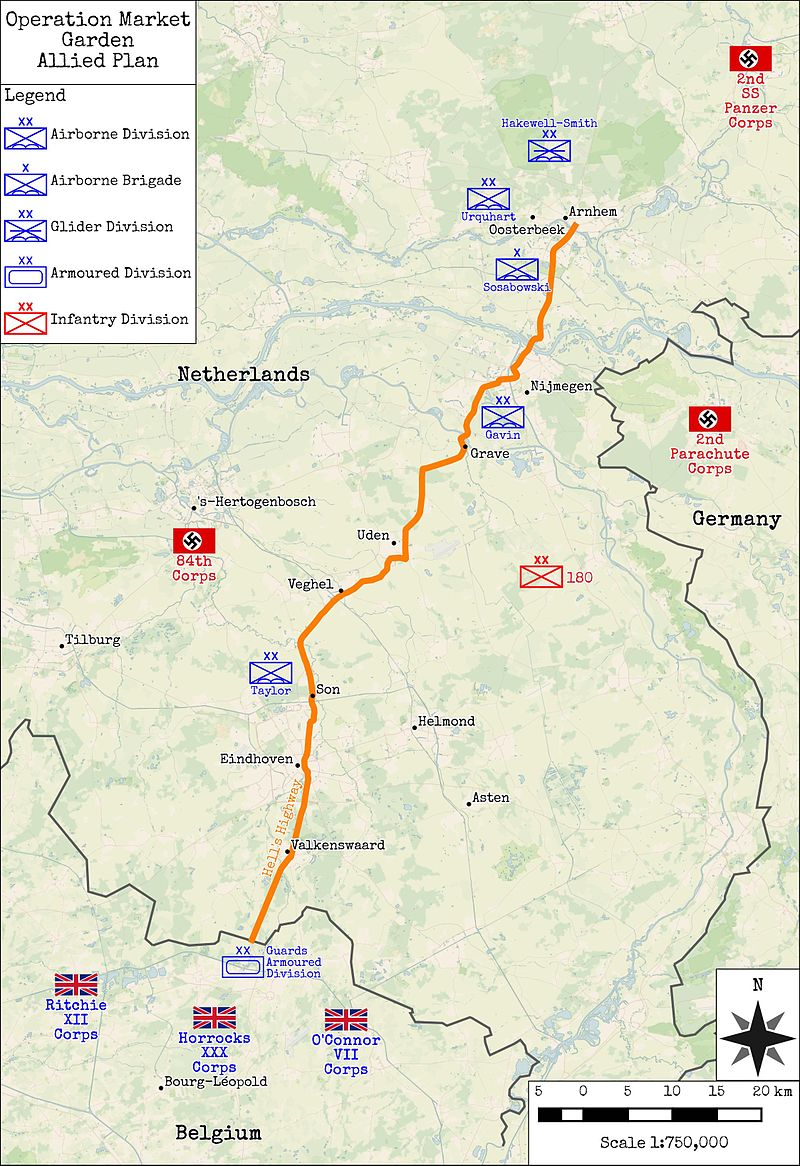
For this purpose, three airborne divisions (US 101st and 82nd, and British 1st) would jump in a corridor over 100km long behind the enemy lines, while a powerful armoured force (The British XXX Corps of the 21st Army Group) would advance and connect the three landing zones.
The task of the three airborne divisions was to capture and defend nine critical bridges, spanning over six major riveras and canals in The Netherlands, until being relieved by the land forces.
For a wargamer, Operation Market Garden opens a wide array of gaming opportunities at different levels, from high strategic-operational levels to very low tactical encounters.
Boardgames are probably best suited for the former. Historically, the airborne landings caught the Germans by surprise and were a total success.
However, these prompted a fast and violent reaction, completely unexpected by the Allied planners, who thought the Germans on the ground were just second rate units and demoralised beyond recovery.
The Germans counterattacks threatening the XXX Corps line of supply along route 69 (the famous "Hell's Highway"), and the fighting to control some of the key bridges along the route are a fantastic context for operational-level games (more on this later). In parallel to the XXX Corps thrust, the US airborne units must simultaneously take and control bridges, defend the landing zones (needed to bring supplies and reinforcements) and retain control of route 69.
 |
| British landing and Attacking Routes |
Therefore, a high level game would see lots of action around the supply routes as the German pressure increases in the post-landing reaction, attacking even at very unfavourable odds. Allied players will have to assume two opposite roles: on the offensive in the south with the armoured corps to link with the different airborne divisions; and defensive in the north to defend any initial gains made in the Arnhem/Oosterbeek area. And players (or group of players) on both sides would have to run against the clock!
The possibilities for low level games using miniatures are also endless. Most wargamers have focused mainly in the desperate battles of the British Airborne Division in Arnhem and surroundings (see for example the event last October at the Oosterbeek Museum organized by TooFatLardies).
While epic and heroic, there are many other alternative scenarios to be played at the scale of battalion or platoon with US Airborne division or with detachments of the XXX Corps: attacks and counterattacks around key bridges; contested epic river crossings; urban fighting (Nijmegen for example); ambush actions on British armoured vanguards... Also noteworthy the variety of army units and motorised hardware used by the Germans to create very attractive visual displays on the gaming tables.
Wargaming Market Garden
In the podcast commented above, I was also put a couple of follow up questions: my favourite wargames to play the operation and reading recommendations.
As for wargaming, my first time recreating market garden was with Storm over Arnhem (SOA), a venerable and iconic game released by the defunct Avalon Hill in the 1980s. This was one (if not the first) to use the area-impulse mechanism instead of the traditional hex-grid map, a revolutionary change at the time. As the title suggests, the game is focused on the British Airborne Division's desperate fight for the bridge at the Arnhem-Oosterbeek area.

The two more recent games I have been playing cover Market Garden fully at operational level: Monty's Gamble and Holland '44
Monty's Gamble fom Multi Man Publishing is another area impulse based game but with a more sophisticated level of development than SOA. I own the second edition released in 2019 and still widely available in hobby shops. The rules are reasonably simple to learn and the game is highly replayable.
 |
| Monty's Gamble Board |
 |
| SOA Board |
Holland '44 form the GMT stable and designed by Mark Simonitch, is my number #1 game for Market Garden. Although more complex than Monty's Gamble, it is fairly accesible for anyone with some track record in playing wargames (but I wouldn't recommend to get anyone introduced to the hobby).

The recently released Spanish version of the game by NAC Wargames is a work of love: incredible high-quality components (pre-cut counters, mounted and paper maps, support tables...), a new scenario published in C3i and a new revised and upgraded edited version of the rules. In fact (confession time) I sold my original GMT English copy to acquire the new NAC edition after watching an unboxing video...and no regrets so far.
On the miniature gaming side (see my previous post discussing board vs miniature gaming), Chain of Command is my best option to play skirmish level actions, as explained before. Too Fat Lardies co-founder Nick Skinner has been working and testing extensively a supplement or handbook focused on Market Garden, that we expect to see released sometime in 2023.

Notably, TFL organised a game day at the Airborne Museum in Oosterbeek in October 2022 and I have just heard the news in a recent Oddcast that a new event is scheduled at the museum premises by the end of October 2023.
Operation Market Garden: What to read?

Cornelius Ryan "A Bridge Too Far" is the early, and now classical work on Operation market garden, that supported the script of the epic film with the same title.
Unfortunately, the book (unlike the film) has not aged well, and some key wrong ideas and facts about the operation have become undisputed myths over time.
More modern works and research are removing some of these myths or questioning decisions taken by some Allied leaders on the ground, like Gavin of the US 82nd Airborne.
For an overview of the whole operation, I recommend "The Battle for the Bridges" by Anthony Beevor, released in 2018. Note: I'm not a devoted fan of this military historian and has found his books to be quite irregular.
But this is a good book to start, despite that some of the myths commented above still survive in his work (for example, the famous "stop to brew tea" of the Guards tanks in Nijmegen after taking the bridge over the Waal).

I have two favourite books that usually I read every year. The first is Martin Middlebrook's "Arnhem the Airborne Battle" dealing with the fight of the British Airborne Division. It is a book rich in details, using first hand views based on veterans' personal letters, diaries and interviews, and extremely well written and documented.
The second is focused on the other side of the hill: Robert Kershaw's "It Never Snows in September". This book tells the story from the German point of view and it is the perfect complement when you read Middlebrook's for example. Also extremely well written and documented, provides a detail review on how and why the German reacted so fast to the landings, as well as a critical view of some of the Allied actions and decisions. A must-have.

Finally, I'd like to bring your attention to a short, widely unknown but intriguing and interesting research study written by Dutch military historian R.G. Poulussen and titled "Lost at Nijmegen: A Rethink on Operation Market Garden".
As the title suggest, the author's argue that Market Garden's main fault was Gavin's procrastinating to take and secure the bridges over the Waal river. The XXX Corps' armoured spear points actually arrived to Nijmegen within schedule despite the problems faced earlier in the operation, only to find the bridges still under German control.
This had a twofold impact: it forced the British units allocated to reach Arnhem to fight a battle to control the bridges; and for the Germans, once Frost's resistance crumbled at the Arnhem bridge, the delay allowed them to fortify and reinforce the section between Nijmegen and Arnhem (The "Island") forfeiting any possibility of the Allies to reach and capture the bridge over the Rhine.
Thank you for reading this. Do you have any special operation or battle close to your heart? Feel free to leave your comments


